
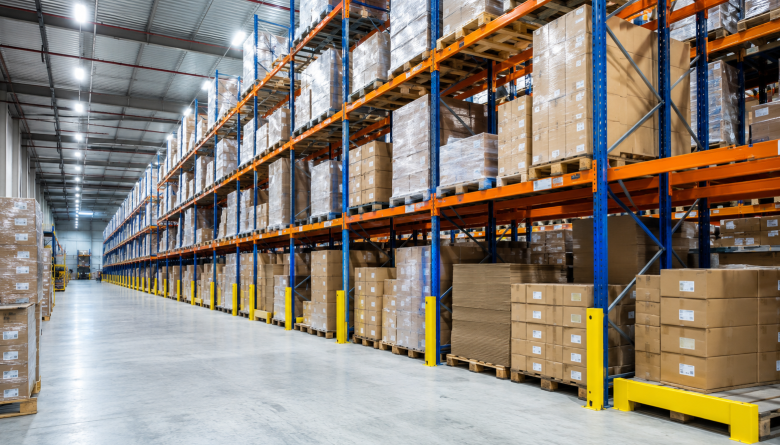
What Is Industrial Racking?
In modern logistics and supply chain management, what matters is not simply the size of a storage area, but how efficiently that space is managed. No matter how large a physical space may be, if it is not properly structured, it can quickly turn into an operational blind spot, creating disorder and serious inefficiencies. Industrial racking systems are professional engineering solutions designed to prevent this complexity and transform storage areas into strategic operational hubs.
Far beyond being mere “metal structures where products are placed,” these systems are designed to optimize space management, accelerate workflow, and maintain operational control in warehouses, manufacturing facilities, logistics centers, and archives. Every business has different product dimensions, weights, turnover rates, and shipping dynamics. Accordingly, industrial racking systems are custom-engineered based on the architectural structure of the warehouse and the specific logistical requirements of the business, forming the hidden yet highly dynamic backbone of warehouse operations.
Advantages of Industrial Racking Systems
The benefits provided by industrial racking systems go far beyond creating a visually organized environment. These systems deliver measurable savings in terms of time, space, and operational costs. By eliminating random product placement and creating clearly defined locations for each product group, racking systems enable daily warehouse operations to be carried out accurately and efficiently.
Especially in businesses with a high number of SKUs, the correct racking configuration plays a critical role. Fast product identification shortens shipping times while enabling accurate stock counts and optimal inventory control. Costs resulting from overstocking or out-of-stock situations, which are common in poorly organized warehouses, can therefore be significantly reduced or eliminated.
Planning safe aisles for employees and material-handling equipment transforms the warehouse from a static storage area into an active, high-performance operational center.
Warehouse Space Efficiency
One of the most common challenges faced by businesses is insufficient warehouse space. However, closer analysis often reveals that the actual problem is not a lack of square meters, but inefficient use of available volume.
Industrial racking systems transfer horizontal storage loads from the floor into the vertical dimension, allowing businesses to make maximum use of the entire height of the warehouse.
Utilizing the cubic volume of an existing facility can eliminate the need for costly investments such as renting a larger warehouse or relocating operations. Turning every centimeter of warehouse space, which is a fixed operating cost, into productive capacity directly improves operational profitability.
When products have clearly defined locations and layouts, unnecessary handling and search times are minimized. This accelerates the entire supply chain, from order preparation to final shipment.
Durability
One of the most critical parameters in the design of industrial racking systems is both static and dynamic structural durability.
These structures may be required to support pallets weighing several tons, industrial machinery, heavy metal components, or high-volume inventory. For this reason, they must be manufactured from high-strength steel in accordance with international standards such as EN and FEM.
Durability does not simply mean supporting products safely. It also means fully meeting occupational health and safety requirements.
Through accurate load analysis, balanced weight distribution, and periodic technical inspections, accident risks within warehouse environments can be minimized.
When selecting a racking system, the decision should not be based solely on initial cost. Load capacity, material quality, engineering calculations, and long-term durability should also be considered.
This approach provides a longer service life and protects businesses from unexpected operational costs such as constant repairs, modifications, and premature system replacement.
Portability
Market dynamics, consumer behavior, and business volumes change over time.
A product category that occupies little space today may require a large portion of the warehouse tomorrow, while an entire product portfolio may also change completely.
To adapt to these changing conditions, industrial racking systems should have modular and portable structures.
Demountable and adjustable racking systems can easily be reconfigured according to changing inventory structures. Shelf heights can be modified, new modules can be added, or the entire system can be relocated to a different area when necessary.
This flexibility creates a sustainable infrastructure for growing and evolving businesses.
By enabling the warehouse to adapt rapidly to business growth and seasonal fluctuations, modular systems provide greater operational flexibility and mobility.
Main Features of Industrial Racking Systems
One of the defining characteristics of industrial racking systems is their ability to make the entire storage ecosystem traceable and controllable.
By standardizing processes and minimizing human error, these systems stand out through their high load-bearing capacity, modularity, fast accessibility, and occupational safety-focused architecture.
Depending on the physical characteristics of the products to be stored, different concepts can be selected, including:
- Back-to-Back Racking
- Drive-In Racking
- Mezzanine Racking
- Cantilever Racking
- Light-Duty Shelving Systems
With the correct system selection, blind spots within the warehouse are eliminated, product visibility increases, and real-time stock tracking can be managed seamlessly, especially when integrated with Warehouse Management Systems (WMS).
Product Safety
In industrial warehousing, product safety is not limited to preventing losses. It also means storing products under conditions that preserve their shape, quality, and commercial value.
Racking systems protect products from floor-level moisture, dust, and potential liquid exposure. At the same time, they prevent crushing and deformation caused by uncontrolled stacking.
This protection is particularly important for sensitive, high-value products or goods requiring special storage conditions.
Product damage resulting from improper or unsafe storage directly translates into financial losses for the business.
By giving each product its own secure storage location, racking systems protect company assets while also reducing the risk of workplace accidents during product access and handling.
Product Categorization
The fundamental principle of sustainable warehouse management is accurate product addressing and classification.
Industrial racking systems allow products to be categorized systematically according to their type, volume, SKA codes, expiration-date priorities, or logistics strategies such as FIFO and LIFO.
FIFO refers to First In, First Out, while LIFO refers to Last In, First Out.
Properly addressed and organized racking systems maximize route efficiency during picking and put-away operations within the warehouse.
Even an employee who has recently joined the operation can reach the correct product within seconds through systematic guidance.
This reduces dependence on individual employee knowledge while supporting organizational memory and long-term operational sustainability.
Environmentally Friendly and Customizable
High-quality industrial racking systems contribute directly to sustainability and circular economy objectives thanks to their long service life.
Manufactured from materials resistant to wear and corrosion, these systems can remain in service for decades without requiring major replacement, helping optimize both raw material and energy consumption.
In addition, every industrial facility and architectural environment has its own unique dynamics.
Rather than relying on standardized solutions, maximum investment efficiency can be achieved through customized designs developed after analyzing all relevant variables, including:
- Warehouse ceiling height
- Floor quality and load capacity
- Forklift type
- Product characteristics
- Storage duration
- Operational workflow
- Inventory turnover
These tailor-made solutions ensure that the storage infrastructure is designed specifically around the needs of the operation.
In summary, industrial racking systems are not simply static metal structures. They are strategic engineering solutions that strengthen the logistical capabilities of a business.
A properly planned storage infrastructure reduces costs, increases operational speed, and provides a safe foundation for future business growth.
A warehouse in which processes operate seamlessly is one of the strongest driving forces behind long-term corporate success.



Leave a Reply