

Rack systems that optimize space management in industrial and commercial areas are critical infrastructure that directly affects businesses’ storage capacity and operational efficiency. As Modern Rack, we provide storage solutions that comply with high occupational safety standards across a wide range of applications, from warehouses and retail stores to logistics centers and factories.
Our main system groups designed according to industry-specific requirements include:
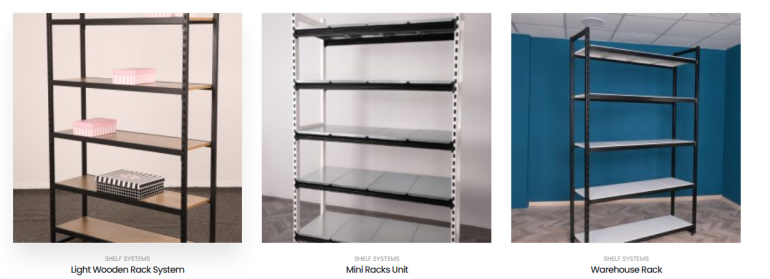
- Storage Rack Systems: Modular and accessible storage structures that maximize vertical space utilization while making product tracking easier.
- Retail Display Systems: Display solutions designed according to customer circulation and ergonomics within stores, helping improve product presentation and sales conversion.
- Heavy-Duty Industrial Rack Systems: Steel construction solutions designed with static load calculations for the safe storage of high-tonnage palletized and bulk loads.
Occupational Safety and Structural Safety in Rack Systems
Rack safety in warehouses and retail environments is one of the most important factors in protecting employee health, product integrity, and business continuity. To ensure structural safety and sustainable operation, Modern Rack applies the following fundamental safety standards:
- Periodic Technical Maintenance and Inspection: In accordance with TS EN 15635 standards, rack systems should be inspected regularly by qualified professionals. Uprights, beams, or bracing components deformed due to impact or metal fatigue should be replaced immediately with original components.
- Compliance with Rated Load Capacity: The beams and upright profiles of each rack module are manufactured according to specific load tolerances (kg per level). Exceeding the maximum load limits per level may cause structural deflection and increase the risk of collapse.
- Balanced Load Distribution and Center of Gravity: When loading products onto racks, weight should be distributed toward the lower levels, while lighter stock should be placed on the upper levels. Uniform distribution of weight across both vertical and horizontal axes helps maintain structural stability.
- Training for Site Personnel and Operators: Ensuring that forklift and material-handling equipment operators are competent in safe driving techniques within rack aisles and understand maximum loading limits helps minimize mechanical damage.
- Static Load Capacity Labels: Clearly visible safety signs displaying the maximum load capacity per level and loading instructions should be placed at the beginning of each rack aisle or block.
- Visibility and Aisle Lighting: Adequate lighting levels in narrow aisles between racks help reduce accident risks during loading and stacking operations.
- Compliance with Occupational Health and Safety Regulations: Rack systems should be designed, installed, and anchored in full compliance with applicable national and international occupational health and safety regulations.
Engineering Criteria to Consider from Design to Installation
The long-term, trouble-free performance of rack systems depends on a carefully managed engineering process from the initial design stage through installation:
- Site and Space Analysis: Warehouse ceiling height, concrete floor quality, column grid positions, and internal circulation routes should be accurately measured and planned.
- Material and Engineering Selection: Depending on the chemical and physical characteristics of the products to be stored, corrosion-resistant electrostatic powder-coated or galvanized steel profiles should be selected.
- Certified Installation Expertise: Incorrect nut tightening or insufficient anchoring of upright posts can reduce the structural strength of the system. Installation should be carried out by certified and experienced teams.
- Process-Oriented Workflow Planning: Rack spacing and aisle widths should be calculated to fully accommodate the turning radii of material-handling equipment used within the facility, such as Reach Trucks, Forklifts, and Pallet Trucks.
- Ergonomic and Emergency Design: Areas where employees perform manual picking should be maintained at ergonomic heights, while vertical clearances between racks should comply with applicable regulations for fire suppression systems such as sprinklers.
Advantages of Modern Rack Systems for Businesses
A properly designed rack infrastructure provides much more than simple storage space, directly contributing to financial and operational efficiency:
- Maximum Vertical Space Efficiency: By utilizing vertical volume without expanding the existing floor area, storage capacity can be increased by up to 200%.
- Operational Speed and Easy Access: Categorizing and properly addressing products significantly reduces order-picking and inventory-counting times.
- Prevention of Product and Stock Damage: By preventing products from being crushed, overturned, or deformed due to improper stacking, rack systems help reduce waste and product losses.
- Sustainable Return on Investment (ROI): Maximizing the efficiency of the existing warehouse space can eliminate or reduce the need for additional rental space or facility expansion.
- Industry-Specific Flexibility: Modular structures can be adapted to the specific inventory dynamics of a wide range of industries, from automotive and logistics to food and retail.





Leave a Reply